The Importance of Regular Fire Safety Inspections
Fire safety is one of those topics that most people acknowledge as important but rarely act on with the urgency it deserves. Whether you own a business, manage a commercial property, or oversee a public facility, regular fire safety inspections are not just a legal formality. They are a critical layer of protection for the people who live, work, and gather in your space. Understanding fire inspection tips, recognizing the safety audit benefits, and knowing how to inspect fire extinguishers properly can mean the difference between a close call and a catastrophe.
Fire-related incidents cause billions of dollars in property damage every year in the United States, and more tragically, they claim hundreds of lives that could have been saved with proper precautions. The good news is that most fire disasters are preventable. A structured, consistent approach to fire safety inspections puts the power of prevention squarely in your hands.
Why Fire Safety Inspections Cannot Be Overlooked
Many building owners and property managers assume that installing fire safety equipment is enough. The truth is that equipment alone provides no protection if it is outdated, improperly maintained, or positioned incorrectly. Fire safety inspections serve as the ongoing checkpoint that ensures every component of your fire protection system is functioning as intended.
Local fire codes require regular inspections for a reason. These regulations are written in response to real disasters, incidents where a faulty sprinkler, a blocked exit, or an expired extinguisher turned a manageable situation into a deadly one. Compliance is not simply about avoiding fines; it is about honoring the intent behind rules designed to protect human life.
Beyond legal compliance, inspections also protect your financial investment. A fire that spreads unchecked because of a malfunctioning suppression system can destroy years of work and assets in minutes. Insurance providers also look favorably on properties with documented, up-to-date fire safety records. In some cases, a consistent inspection history can even lower your premiums. The safety audit benefits extend far beyond the immediate moment of inspection.
Core Fire Inspection Tips Every Property Owner Should Know
Knowing where to start with fire safety can feel overwhelming, especially for those managing large or complex properties. Breaking the process into clear categories makes it far more manageable. These fire inspection tips are designed to give you a practical starting point.
Begin with your exit routes. Every building must have clearly marked, unobstructed pathways leading to safe exits. During an inspection, walk each route and ask yourself whether someone unfamiliar with the building could find their way out in low-visibility conditions. Exit signs should be illuminated and functional at all times. Emergency lighting should activate immediately in the event of a power failure.
Next, examine your fire detection systems. Smoke detectors and heat sensors need to be tested regularly, and their batteries or power connections should be verified. Many facilities install systems but neglect to test them on a scheduled basis. A smoke alarm that fails during a real fire offers zero protection, which is why testing is just as important as installation.
Electrical systems deserve careful attention as well. Overloaded circuits, frayed wiring, and improperly grounded outlets are among the leading causes of structural fires. During any fire safety inspection, a licensed electrician should periodically assess your electrical infrastructure, particularly in older buildings where the wiring may not meet current safety standards.
Storage practices also play a role in fire safety. Flammable materials should be stored in designated areas, away from heat sources and in properly labeled, sealed containers. Clutter in hallways, stairwells, and near electrical panels creates both ignition risks and evacuation hazards. Keeping these areas clear is one of the simplest and most effective fire inspection tips you can implement immediately.
How to Inspect Fire Extinguishers the Right Way
One of the most commonly overlooked aspects of fire safety is the condition of fire extinguishers. People tend to treat them as permanent fixtures, assuming they will work when needed simply because they are present. However, fire extinguishers have a limited service life and require both routine visual checks and periodic professional inspections.
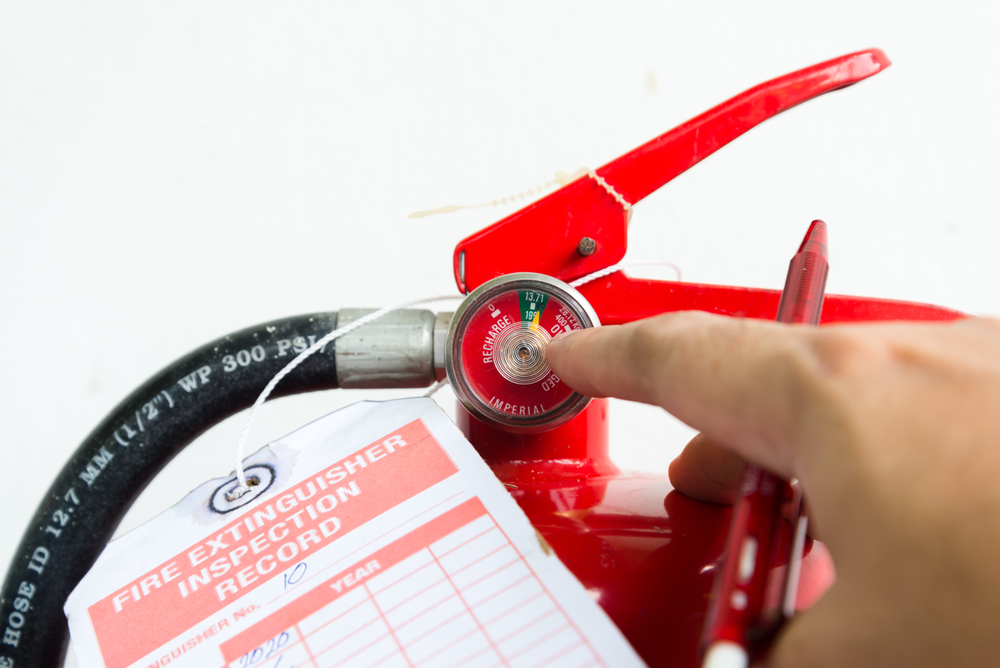
To inspect fire extinguishers effectively, start with the basics. Check that the extinguisher is mounted in its designated location and is clearly visible and accessible. It should never be blocked by furniture, equipment, or stored materials. The pressure gauge should read in the green zone, indicating that the unit is adequately charged. If the needle falls outside that range, the extinguisher needs to be recharged or replaced immediately.
Examine the physical condition of the unit. Look for dents, corrosion, or any signs of physical damage that could affect its reliability. The safety pin should be intact, and the tamper seal should be unbroken. If the seal is missing, the extinguisher may have been used or tampered with and should be inspected by a professional before being returned to service.
Check the inspection tag attached to the extinguisher. This tag records the history of professional inspections and maintenance. Most fire codes require that extinguishers be professionally inspected at least once per year. Beyond annual inspections, extinguishers also require a more thorough internal examination every six years, and certain types must be hydrostatically tested every twelve years.
It is also important to match the type of extinguisher to the hazards present in each area of your building. A Class A extinguisher is appropriate for ordinary combustibles like wood and paper, while a Class B unit handles flammable liquids. Class C extinguishers are designed for electrical fires, and Class K units are specifically made for commercial kitchen environments. Using the wrong type of extinguisher on a fire can make the situation significantly worse, so placement and type selection are critical components of any fire safety plan.
Training your staff or occupants to actually use extinguishers is equally important. An extinguisher that no one knows how to operate is barely more useful than no extinguisher at all. Regular drills and basic training using the PASS technique (Pull, Aim, Squeeze, Sweep) should be part of your overall fire safety program.
The Long-Term Safety Audit Benefits of Consistent Inspections
A single fire inspection provides a snapshot of your safety status at one point in time. The real value, however, comes from conducting inspections consistently and tracking the results over time. This is where the broader safety audit benefits become most apparent.
When you maintain a detailed log of every inspection, you begin to see patterns. You may notice that a particular area of your building repeatedly fails inspection due to blocked exits or equipment issues. That pattern signals a systemic problem, whether it is a workflow issue, a lack of staff awareness, or a design flaw that needs to be addressed. Without consistent records, these patterns remain invisible.
Regular audits also build a culture of accountability. When staff members know that fire safety is taken seriously and reviewed on a schedule, they are more likely to maintain standards between formal inspections. The culture of safety that develops around a consistent inspection program is one of the most enduring safety audit benefits any organization can cultivate.
Documentation also protects you legally. In the unfortunate event of a fire-related incident, having thorough records of your inspection history demonstrates due diligence and can be critical in limiting liability. Courts and insurance companies alike look at the paper trail when evaluating responsibility.
Conclusion
Regular fire safety inspections are a foundational responsibility for anyone who manages a property or oversees the well-being of others. By following practical fire inspection tips, committing to consistent efforts to inspect fire extinguishers, and embracing the long-term safety audit benefits that come with structured audits, you create an environment where people can live and work with confidence. Fire safety is not a one-time task. It is an ongoing commitment that pays for itself many times over.
Need Life Safety Products Near You?
There are various forms of personal protection. We offer fire safety and fire prevention equipment including fire extinguishers, and we service them, too. Business owners throughout Southwest Kansas should know what types of personal protection or fire safety equipment is necessary to suit the needs of their business. Rather than struggling with purchasing decisions, discuss with our consultants from C.F. Fire & Life Safety and let us guide you through the logistics. Based in Liberal, KS, C.F. Fire & Life Safety, is your destination for personal protection, fire safety, fire prevention, and fire extinguisher services throughout Southwest Kansas. Contact us today to learn more about what we can do for you!